

Recap & Resources from: Designing for Impact - Social Investment & Mental Health Spaces Webinar
From Funding Innovation to Better Neighbourhood Environments
Recap from our April 2026 Lunch & Learn Webinar
On Tuesday, 21st April 2026, the Design in Mental Health Network Charity (DiMHN), in partnership with Social Finance, welcomed professionals from across healthcare, estates, local government, design, research and the voluntary sector to our free Lunch & Learn webinar exploring an important question:
What is social investment, and how could it help us invest in buildings and places that support better neighbourhood mental health?
This timely and thought-provoking session introduced new funding approaches, practical case studies, and evidence-informed perspectives on how design and investment can work together to improve community mental health outcomes.
Get Involved: Help Shape the Follow-Up Working Session
This webinar was designed as an introduction to the opportunity at the intersection of social investment, neighbourhood health and mental health environments, and the conversation does not end here.
DiMHN and Social Finance are now planning a practical follow-up working session for those who would like to explore the topic in more depth.
This next stage will focus on moving from ideas to action, helping participants examine how innovative funding models, partnership approaches, and better design thinking could be applied in real-world projects and places.
We are inviting attendees to complete a short 3 to 5-minute feedback and interest form to help shape the next session around the issues that matter most.
The form includes opportunities to share:
- The key challenges you face in delivering or supporting mental health spaces
- What felt most relevant or useful from the webinar
- Where you see the greatest opportunity for social investment
- Whether you are currently developing a related project or idea
- Interest in contributing a future case study
- What you would most value from a follow-up session
Possible formats may include:
- Interactive workshop
- Case study deep dives
- Expert-led discussion
- Small group collaboration
- Peer learning and networking
At DiMHN, we believe meaningful change happens through collaboration, lived experience and evidence-informed design. Your insights will help shape a practical next step for this growing conversation.
Please note: Proceeding with a second event will be subject to sufficient demand.
Why This Matters
Community and neighbourhood mental health spaces are often underfunded, outdated, or inflexible, yet they are essential to preventive care, connection, recovery, and wellbeing.
As the NHS and wider system increasingly focus on neighbourhood health models, this webinar explored how social investment, outcomes-based funding, and better design thinking could help unlock progress.
Hosted by Dr Sara Felix, Director of Engagement & Influence at Social Finance, the session brought together expertise from finance, health systems, design and research.
Speakers & Topics
Welcome & Chair

Dr Sara Felix
Director of Engagement & Influence, Social Finance
Keynote
Introducing Social Outcomes Partnerships and their relevance to community health

Toby Eccles
Founder and Director of Development, Social Finance
Case Study
Neighbourhood Transformation Funds in practice

Katy Nex
Director and Social Investment in Health & Social Care Lead, Social Finance

Ros Nerio
Development Director, South and West Hertfordshire Health and Care Partnership
Translating research on ‘restorative environments’ into real-world design

Hannah Arnett
Senior Editor, Cities & Health
Bridging design and infrastructure delivery in community settings

Anisha Mayor
UK Head of Healthcare, WSP
Considering design principles: as enablers of care

Charlotte Burrows
CEO, the Design in Mental Health Network charity
Key Themes & Insights
1. What is Social Investment?
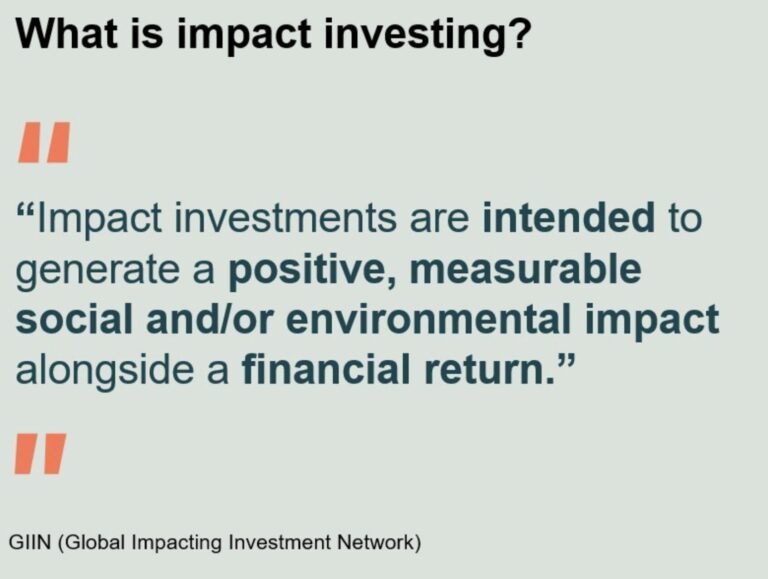
Toby Eccles opened the session by introducing the principles of impact investing and social outcomes partnerships.
Rather than funding services purely through traditional grants or annual budgets, these models aim to direct investment toward projects that generate measurable positive outcomes, allowing systems to pay for what works.
This can help unlock funding for prevention, innovation and long-term transformation where conventional routes often struggle.
A key message was clear:
If we only fund crisis response, we make prevention harder.
2. Breaking the Cycle: Funding Prevention
Katy Nex explored how current systems often concentrate spending in acute services, leaving little room for preventative community support.
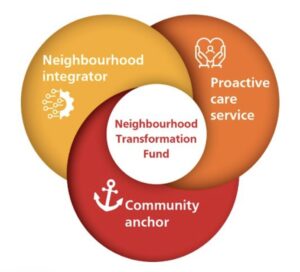
She introduced the concept of a Neighbourhood Transformation Fund, a place-based model designed to attract investment into earlier intervention, community services and neighbourhood health.
This approach seeks to:
- Shift spending from treatment to prevention
- Create multi-year rather than short-term funding models
- Support innovation without placing all risk on stretched public services
- Strengthen partnerships across sectors
3. A Real-World Example: West Hertfordshire
Ros Nerio shared how South and West Hertfordshire Health and Care Partnership is using this model to support people living with frailty through proactive, wraparound neighbourhood care.
The programme focuses on individuals most at risk of hospital admission and provides targeted support earlier, improving outcomes while reducing pressure on acute services.
Ros highlighted the importance of:
- Multi-year thinking
- Cross-sector collaboration
- Better use of resources
- Community-rooted delivery models
- Voluntary, community and faith sector partnerships
Her reflections offered a powerful example of how alternative finance can enable practical change.
4. Designing Restorative Community Environments
Hannah Arnett brought the lens of research and urban health to the conversation, exploring how neighbourhood environments themselves influence mental wellbeing.
She highlighted evidence that wellbeing is shaped not only by services, but by the spaces people move through every day.
Key factors included:
- Quality of local infrastructure
- Access to green and blue spaces
- Social connection and belonging
- Inclusive design
- Participation in shaping place
- Safe, welcoming public environments

Live Poll Results: What the Audience Told Us
The webinar included interactive polling with 43 responses.
We asked:
How often are communities involved in shaping neighbourhood spaces for mental health?
- Always – 0%
- Often – 16%
- Sometimes – 53%
- Rarely – 30%
Are existing community assets being used effectively?
- Fully utilised – 7%
- Partially utilised – 21%
- Underutilised – 60%
- Not sure – 12%
Most overlooked assets in communities?
The strongest response by far was:
Green spaces
Other suggestions included:
- Community centres
- Public social spaces
- Faith buildings
- Shops and corner stores
- Leisure settings
- Gardening clubs
- Inclusive spaces
What value is most overlooked in social investment?
- Prevention / early intervention – 34%
- Community cohesion and belonging – 29%
- Long-term place-based change – 12%
- Economic/system savings – 12%
- Lived experience and agency – 10%
These results strongly reflected the themes of the session: prevention, place, belonging and untapped community assets.
Hannah reflected after the webinar’s polls:
“Encouraging to see there’s agreement with opportunity to do more to utilise spaces with communities – and the breadth of types of spaces to support mental health.”
5. Designing Neighbourhoods of Prevention
Anisha Mayor and Charlotte Burrows reinforced a core DiMHN principle:
Buildings, streets and neighbourhoods are not neutral. They shape how people feel, move, connect, access support and experience care.
Anisha Mayor brought a powerful prevention-focused perspective, encouraging attendees to think beyond individual buildings and consider the wider environments around neighbourhood health centres.
She highlighted growing evidence that access to green and blue spaces, walkable neighbourhoods, clean air and inclusive public infrastructure can significantly improve wellbeing and reduce anxiety and depression.
She discussed the concept of “neighbourhoods of prevention” focused on designing places that help people stay well in the first place — not simply responding when health declines.
Key themes included:
- Walkability and cyclability to support movement and independence
- Green and blue spaces as everyday mental health assets
- Intergenerational living and shared community spaces that reduce isolation
- Clean air and healthier urban environments
- Accessible streets, routes and transport systems designed with communities
- Designing for those with the greatest barriers to health, particularly underserved populations
Anisha also emphasised the need to measure outcomes differently — considering stress reduction, happiness, safety, quality of life and social connection, not just traditional financial metrics.
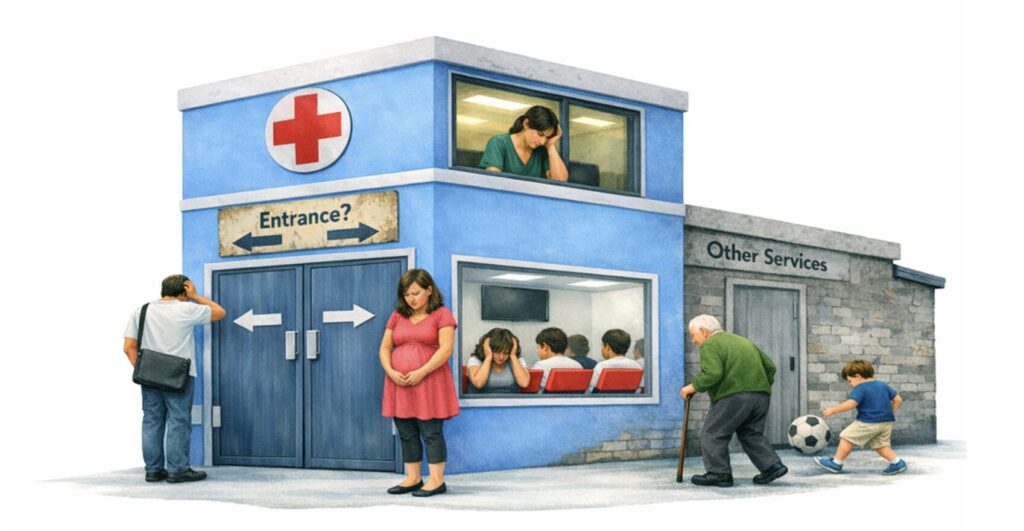
Charlotte Burrows then brought the discussion into healthcare settings themselves, noting that too often design is treated as cosmetic rather than recognised as part of the care solution.
There is also a critical equity dimension.
Poor environments are not evenly distributed. They are often found in areas of greatest need, reinforcing existing inequalities.
Design can either reproduce these patterns or help to address them.
When environments are shaped around narrow assumptions or “default users,” they exclude large groups of people
She highlighted practical opportunities such as:
- Improving access to natural light and reducing glare can support regulation and wellbeing
- Reducing noise and improving acoustics can lower stress and agitation
- Using calmer materials and colours can support engagement
- Clear wayfinding can reduce confusion and anxiety
- Better ventilation and sensory environments can improve overall comfort
Individually, these may seem minor. But together, they shape whether a space supports care or works against it.
Together, their message was clear:
If we want better mental health outcomes, we must design both better buildings and better neighbourhoods.
Watch Back, Slides & Next Steps
Missed the live session or want to revisit key ideas?
Upcoming Design in Mental Health Network Webinars
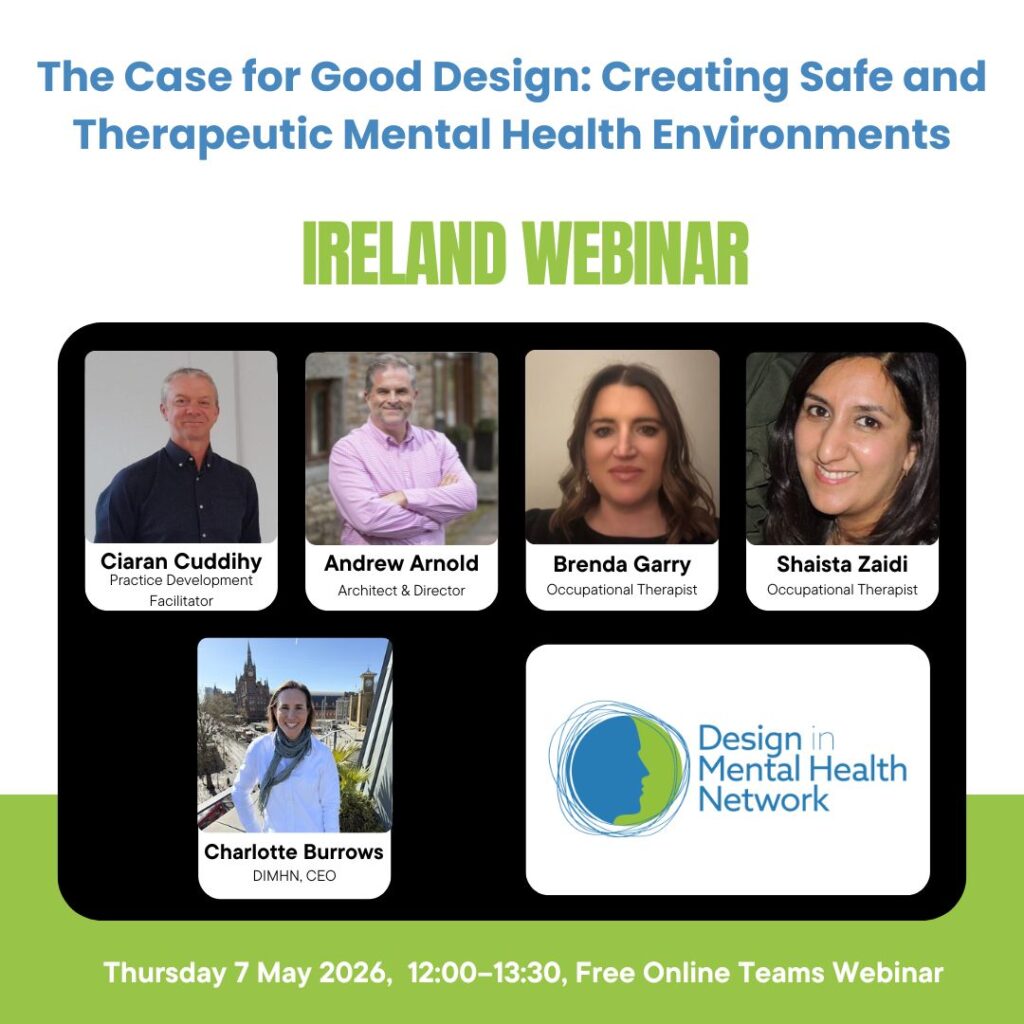
Ireland Webinar
Free Lunch & Learn Webinar
How can good design improve safety, support recovery, and shape better mental health care?
 Thursday, 7 May 2026 |
  12:00–13:30 GMT |
  Online (Teams) |
  Cost: Free
Design is not neutral. It shapes safety, behaviour, and recovery.
How can good design improve safety, support recovery, and shape better mental health care?
Join the Design in Mental Health Network (DiMHN) for this free webinar exploring how evidence-informed, human-centred design can improve outcomes for service users, staff, and services
Bringing together clinicians, estates professionals, architects, designers, and people with lived experience, this session will explore how the built environment shapes care in practice. From early engagement and co-production to retrofitting existing buildings, speakers will share practical insights into creating safer, more therapeutic environments within real-world constraints.
Attendees will gain practical insight from across disciplines on how good design can reduce risk, support staff wellbeing, and enable more effective, compassionate care.
You’ll also learn how to access free DIMHN resources, CPD opportunities, and join a growing community of practice focused on improving mental health environments.
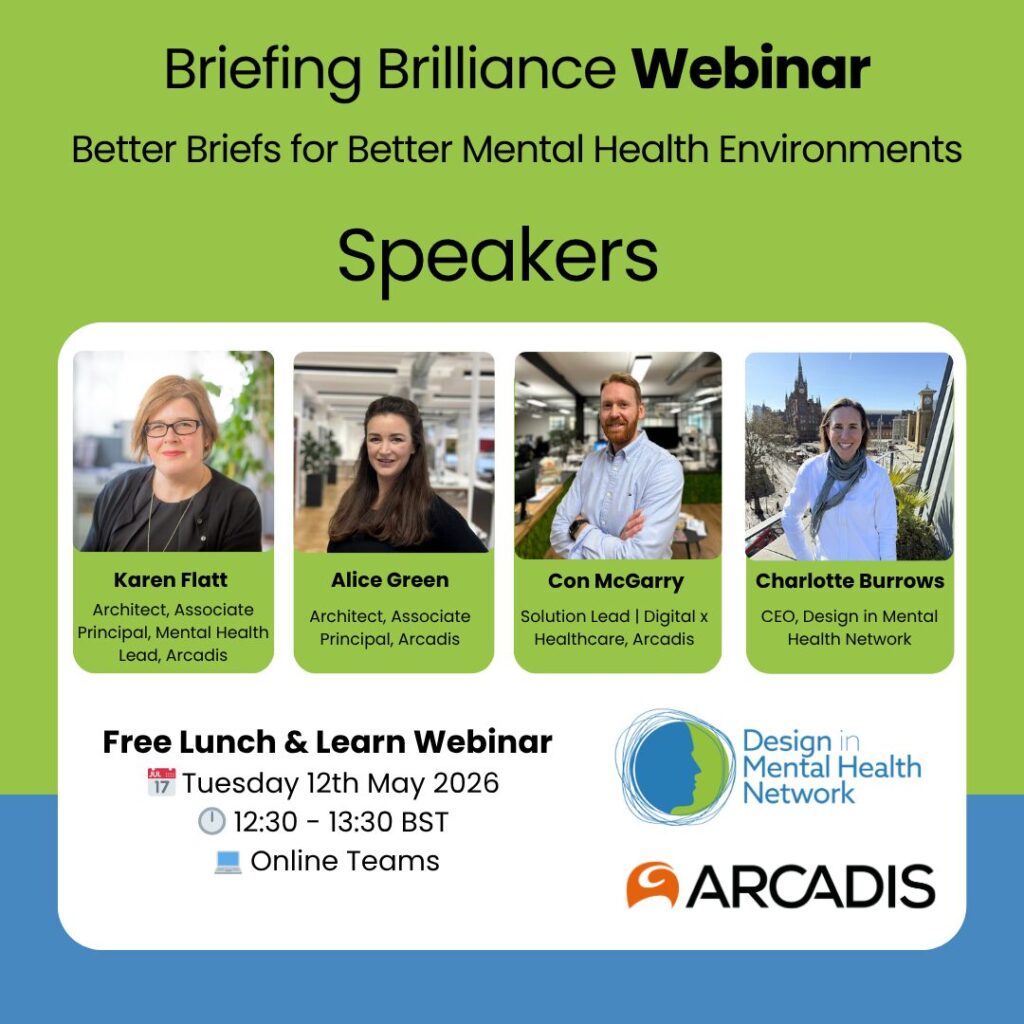
Design in Mental Health Network & Arcadis Webinar
Free Lunch & Learn Webinar
How can good design improve safety, support recovery, and shape better mental health care?
Tuesday 12th May 2026 | 12:30 – 13:30 BST | Online (Teams)
Why Briefing Matters in Mental Healthcare
A well-crafted brief is one of the most powerful tools in shaping mental health environments.
Done well, it aligns stakeholders, reduces costly redesign, and ensures that spaces genuinely support recovery, dignity, and wellbeing. Done poorly, it can lead to missed opportunities, wasted resources, and environments that fall short of the needs they are meant to serve.
At the Design in Mental Health Network, we believe that better briefs lead to better outcomes for people, for services, and for the public purse.
This 60-minute Lunch & Learn webinar explores how to strengthen briefing in practice, with a particular focus on the role of personas, stakeholder insight, and real-world application.
If you’re working in estates, design, mental health care, or social finance, this webinar is just one conversation. DiMHN brings together the lived experience, clinical knowledge, and design innovation needed to shape the future of care environments.
> Become a DiMHN member or partner with us
📆 Save the Date: DiMHN 2026 Conference | 2–3 June 2026 | Coventry Building Society Arena – book your passes here