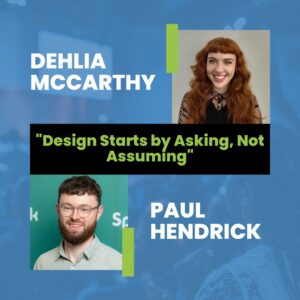

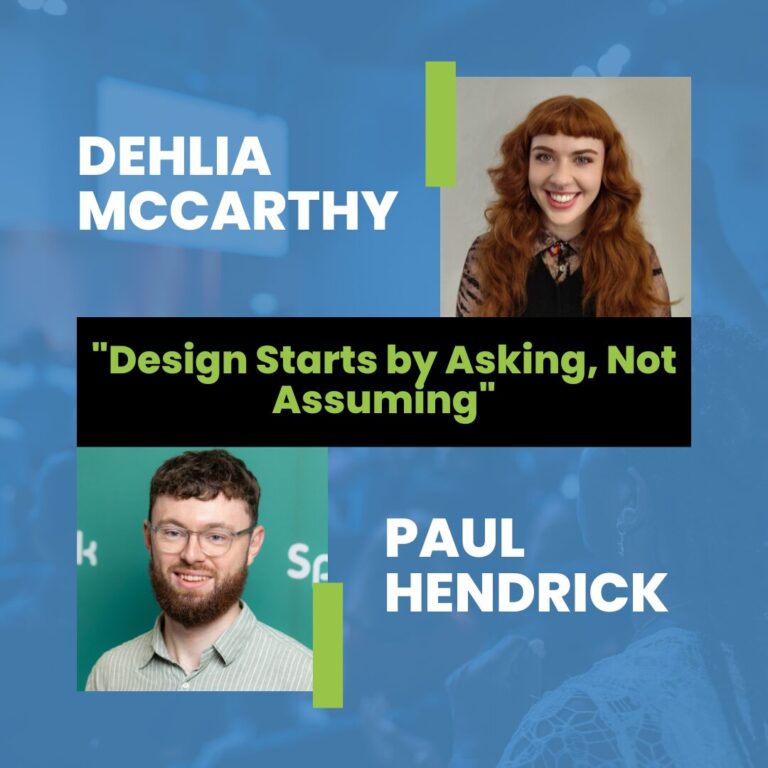
Children’s Health Ireland’s Dehlia McCarthy and Paul Hendrick believe the most effective healthcare environments aren’t created through assumptions or technology alone, but by listening to the people who experience them every day. Ahead of Design for Healthcare Environments Ireland, they explain why humility may be the most important design tool of all.
Children don’t experience healthcare as a collection of departments, pathways or buildings. They experience a journey.
From receiving an appointment letter at home, to navigating unfamiliar corridors, waiting for treatment, meeting new faces and returning home again – every interaction shapes how safe, informed and supported they feel. For many children and families, those experiences become part of everyday life.
Designing better healthcare environments, therefore, means designing far more than just buildings. It means having a deep understanding of the people who use them.
At Children’s Health Ireland (CHI), Service and Interaction Designers Dehlia McCarthy and Paul Hendrick spend their days doing exactly that. Working alongside children, families, and multidisciplinary clinical teams, they help uncover experiences that often go unseen, translating those insights into practical improvements across services, communication, digital tools, and physical environments.
Their approach is built around one key principle:
Nothing for us without us.
It is a philosophy rooted in humility and empathy.
Not the humility of lowering expectations, but the humility to recognise that however experienced you are as a clinician, architect, designer or manager, you are not the expert in someone else’s experience.
“We often say that when you assume,” laughs Dehlia, “you make an ass of you and me.”
It’s a line that raises a smile, but it also captures one of the biggest challenges facing healthcare design. Too often, organisations begin with solutions rather than questions. A new form. A redesigned space. A digital platform. An emerging technology.
What if the real problem lies somewhere else entirely?
Designing with curiosity, not certainty
Neither Dehlia nor Paul followed a conventional route into healthcare. Both studied Product Design before completing a Master’s in Interaction Design at Ireland’s National College of Art and Design. A collaborative project with the Mater Hospital opened Dehlia’s eyes to a different kind of design practice, one where creativity could have a direct impact on people’s lives.
“I realised this was design that genuinely helps people,” says Dehlia. “Every project is different, you’re constantly learning and you’re making a positive difference.”
Paul arrived at the same conclusion from a different angle, having long been interested in designing products and services for children.
“I always wanted to design to help people,” he explains. “The idea of creating products simply for commercial reasons never really appealed.”
Today, both are part of CHI’s Innovation Team, working with clinical and operational colleagues to improve experiences across the organisation.
For them, design is not defined by what it produces, but by how it works.
People often hear the word “design” and think about the thing being created: a digital tool, a leaflet, or a new space. Human-centred design turns that idea on its head.
“People skip over the ‘human-centred’ part,” Dehlia says. “The focus isn’t the thing you’re designing. It’s how you’re designing it.”
That means bringing the right people into the conversation, making sure every perspective is heard and resisting the temptation to jump to solutions too early.
As Paul puts it, “It’s 80% process, 20% outcome.”
Rather than disappearing into a design studio and returning with a finished answer, they bring clinical teams through every stage of the process, helping them understand the questions being asked and, ultimately, equipping them to apply the same thinking to future projects.
It’s why Dehlia describes themselves as “more guides than leads”.
That distinction matters. Their role is not to arrive with the answers, but to create the conditions for better answers to emerge. By bringing clinicians, patients, families and colleagues through the design process together, they help teams build the confidence to ask different questions, and increasingly, to ask those questions without the designers in the room.
One of the biggest misconceptions about human-centred design is that it slows projects down. In reality, Paul argues, the opposite is often true.
“Healthcare systems are full of well-intentioned fixes/patches that address symptoms rather than causes. New processes are introduced, workarounds become permanent, and resources are repeatedly invested in patching the same problems.”
Human-centred design challenges that cycle.
By taking the time to understand what people are actually experiencing, organisations are far more likely to identify the root cause and develop solutions that last.
“People often think this approach takes longer or costs more,” Paul reflects. “But if you solve the right problem the first time, you’re not spending years patching it afterwards. The long-term cost savings can be significant; we seem to be saving people a lot of money.”
Better experiences and better value are not competing objectives. More often than not, they go hand in hand.
For Dehlia, the value extends far beyond financial savings or even the immediate success of a project.
“Today’s child is tomorrow’s healthy adult,” she says. Every positive healthcare experience helps shape a child’s confidence in seeking care throughout their life. A child who feels safe, listened to and respected today may be less fearful of visiting a doctor as an adult, more likely to engage with healthcare when they need it and, ultimately, experience better long-term health outcomes.
The wider impact of that, she suggests, is impossible to measure, but will be significant.
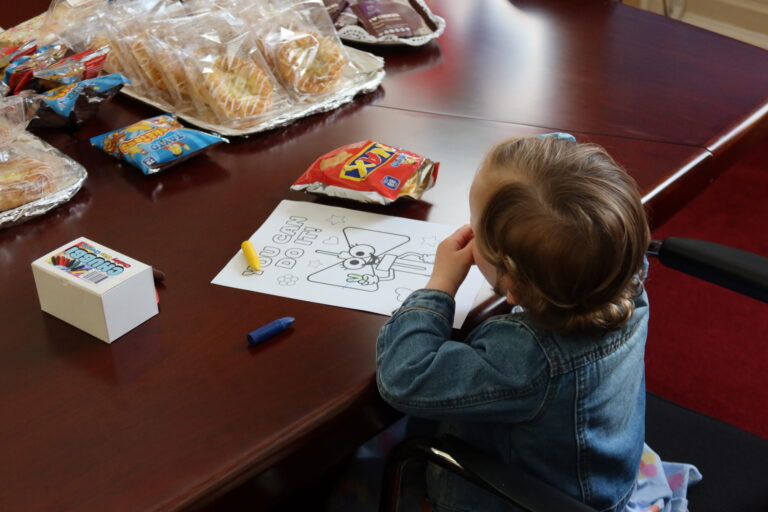
The problem you think you have is rarely the one you actually have
Every project starts with a conversation.
It is an approach rooted in humility and empathy, the recognition that no one can fully understand a problem until they’ve listened to the people living with it.
Experience has taught them that most assumptions are usually wrong.
Clinical teams can sometimes approach them with a solution already in mind.
Perhaps a new app.
Perhaps redesigned information.
Perhaps a different process.
Their response is always the same. As Dehlia says, “How do we know that’s actually the problem?
Have we spoken to the children? Have we asked parents? Have we understood what staff are experiencing every day?”
Again and again, those conversations reveal something unexpected.
“The problem is nearly always different from what people first think.”
It is one of the most valuable contributions designers can make; not providing answers, but helping organisations ask better questions.
“Human-centred” means everyone
Although “patient-centred care” is now firmly embedded within healthcare across Ireland, Dehlia believes human-centred design takes a broader view.
“It’s about the patient, but it’s also about parents, carers and staff,” she explains. “There’s no point creating something that’s wonderful for patients if it’s impossible for staff to deliver well.“
Paul recalls projects where administrative teams proved just as influential as clinicians, patients and parents, in shaping the overall patient experience.
Supporting staff, reducing friction and improving communication often creates benefits that ripple throughout an entire service.
Good design recognises that healthcare is an ecosystem. Improving one part inevitably affects another; it has a ripple effect.
Listening changes everything
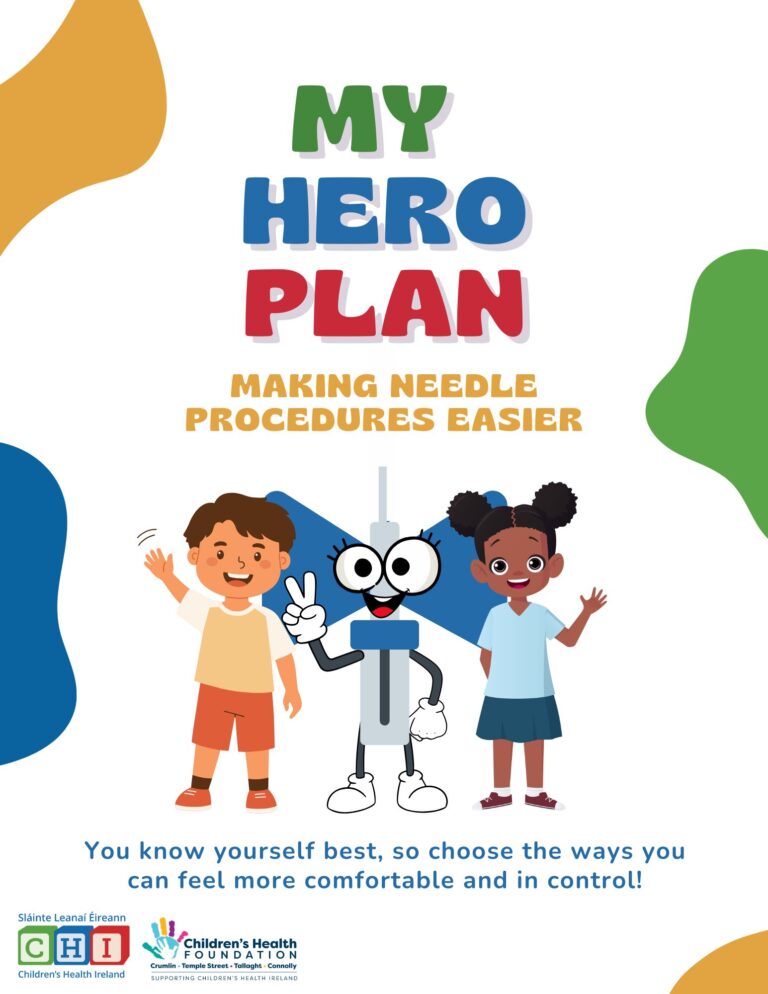
One of the clearest examples came during the development of Needle Heroes, a project supporting children undergoing needle procedures.
Initially, professionals assumed information should primarily be directed towards parents. The young people themselves had other ideas.
Some wanted detailed explanations. Others preferred only enough information to feel prepared. Many wanted practical advice rather than reassurance alone.
Could they bring a favourite toy?
Would it help to drink water beforehand?
What choices could they make for themselves?
“They’ll tell you exactly what they need,” says Dehlia. “You just have to ask.”
That lesson runs through every project they describe.
- The redesigned asthma action plan.
- Support for children transitioning into adult services.
- Communication with families of children with profound neurodisabilities.
- Projects exploring neurodiversity.
In every case, listening reshaped the brief.
Not because professionals lacked expertise by any means, but because
lived experiences revealed something expertise alone could not.
Their work around neurodiversity has reinforced another important lesson: flexibility matters. No two children experience healthcare environments in exactly the same way. One child may find a busy waiting room reassuring, another overwhelming. One may want detailed information before a procedure, another may prefer only the essentials.
Rather than searching for a single perfect solution, their aim is to create environments and services that can adapt to different needs and different ways of experiencing care.
Parents and children are part of building better solutions
One of the clearest examples came during the redesign of an asthma action plan for children.
On the surface, the brief seemed straightforward: improve the information families received.
But rather than producing a finished design, Paul began with rough ideas and took them back to the people who would actually use them.
Week after week, he met with different children and parents, testing concepts, listening to feedback and refining the design. Each conversation revealed something new. The result wasn’t simply a better leaflet.
It became something far more engaging than the design team had originally imagined.
Children wanted to colour in images of their inhalers in the correct colour. They wanted illustrations they could relate to. They wanted to personalise the information and make it their own.
What emerged wasn’t the product of a designer’s imagination alone. It was the product of an iterative conversation between designers, children and families. “The final version was far better than anything we would have created by ourselves,” Paul reflects.
That same principle runs through every project they describe.
From Needle Heroes to transition planning for young people with complex disabilities, each project begins with the assumption that the first answer is unlikely to be the best one.
The people using healthcare don’t simply validate a finished design. They help create it.
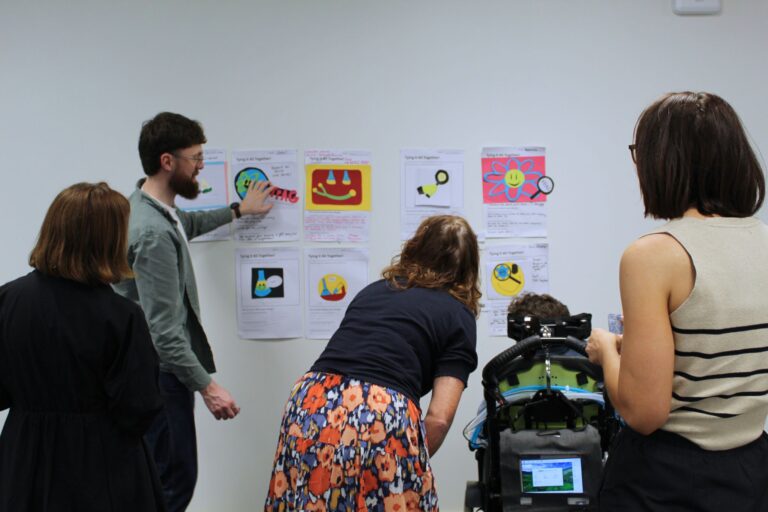
Where the Real Conversations Happen
The phrase “co-production” appears frequently in healthcare strategies. For Dehlia and Paul, it is much simpler than many organisations imagine.
Sometimes the most valuable conversations happen in waiting rooms rather than meetings or brainstorming workshops.
Parents waiting for appointments often have time to reflect on their experiences. Children are remarkably honest about what works and what doesn’t.
As designers rather than clinicians, Dehlia and Paul also occupy a uniquely neutral third-party position. Families are often more willing to speak openly. Staff are less likely to feel criticised.
The result is a richer understanding of how services really function. Meaningful co-production is not a single consultation exercise. It is an ongoing habit of listening.
Innovation isn't the starting point
One moment in our conversation neatly summed up their philosophy.
“Innovation has been co-opted into technology,” Paul observes.
Artificial intelligence.
Virtual reality.
Digital transformation.
All have enormous potential.
But only if they emerge in response to genuine needs.
“You don’t start with AI, for example” he says.
“You start with the problem.”
The team begins by understanding the service, listening to different perspectives and identifying where the real opportunities lie. If one of those opportunities is best addressed through AI, immersive technology or another digital solution, then it becomes part of the conversation naturally. Not because the technology was driving the project, but because it genuinely meets a need.
Paul offers simple examples. AI might help provide real-time translation where access to interpreters is limited. Virtual reality could help children become familiar with an unfamiliar healthcare environment before they arrive. In each case, the technology supports the solution rather than defining it.
A useful reminder that technology is a tool, not a strategy.
The most important innovation often happens long before any technology is considered.
For Dehlia, the clearest sign that this approach is working isn’t a finished project; it’s hearing clinicians ask questions they might not have asked two years ago.
Have we spoken to parents?
What do young people think?
How are staff experiencing this?
When those questions become part of everyday practice, human-centred design has moved beyond individual projects and begun to change organisational culture.
Small changes can have extraordinary impact
Not every successful project involves complex technology or major investment.
One of the simplest innovations began with a nurse who bought a whiteboard and placed it inside a patient’s room. Before each handover, staff could note simple but important details: how the patient preferred to be addressed, how they were feeling that day, or anything else the next team should know. It helped ensure every shift started with the person, not just their clinical notes.
The idea proved so effective that it evolved into dedicated bedside communication boards, now incorporated into new hospital rooms. A low-cost intervention, born from frontline experience, became a practical way to improve continuity of care and strengthen the relationship between patients and staff.
It was another reminder that innovation doesn’t always mean inventing something new. Sometimes it means recognising the value of staff’s ideas, working to develop and scale them to reach more people.
Relatively modest interventions produced meaningful improvements because they reflected what people actually needed.
Listening, it turns out, is often the most cost-effective intervention of all.

The experts in their own experience
Throughout our conversation, one message surfaced again and again.
Healthcare professionals are experts in healthcare.
Designers are experts in design.
Architects are experts in buildings.
But patients, families and staff are experts in something equally valuable.
Their own experience.
That may sound obvious, yet it is a truth healthcare systems continually have to relearn. Humility means recognising that expertise is shared.
The role of design is not to replace clinical knowledge, but to bring different forms of expertise together in pursuit of better outcomes.
Perhaps that is why “Nothing for us without us” resonates so strongly.
It is more than a slogan.
It is a challenge.
Before designing a building.
Before redesigning a service.
Before introducing a new technology.
Before writing a policy.
Pause. Ask. Listen.
Because the best healthcare environments are not created by assuming what people need. They are created by understanding what matters to them.
And that begins with the simplest act of all: recognising that the people who experience healthcare every day are the experts in their own lives.
Looking Ahead and Sharing Learnings
Looking ahead, both are clear that the ambition extends beyond individual projects. Success isn’t measured solely by positive feedback or a well-received intervention. It’s about understanding the long-term impact of those improvements, seeing good ideas adopted elsewhere and creating a culture where organisations learn from one another rather than solving the same problems in isolation.
That ambition is already beginning to take shape within Children’s Health Ireland. As demand for human-centred design continues to grow, so too does the team, with plans to bring in additional designers and expand the organisation’s capacity to support improvement across more services. For Dehlia and Paul, it’s an encouraging sign that design is increasingly being recognised not as an optional extra, but as a strategic capability for delivering better healthcare.
Across Ireland and beyond, many hospitals and healthcare providers are grappling with remarkably similar challenges. Too often, valuable learning remains within a single ward or organisation. By sharing practical experiences – what worked, what didn’t and what changed as a result. Healthcare can move forward together, avoiding duplication and accelerating improvement.
That is why conversations like those taking place at Design for Healthcare Environments Ireland matter. They provide an opportunity not simply to showcase projects, but to exchange ideas, challenge assumptions and build on each other’s learning. Because if the best solutions are created by listening, the next step is making sure those lessons are heard.
Continue the Conversation at Design for Healthcare Environments Ireland
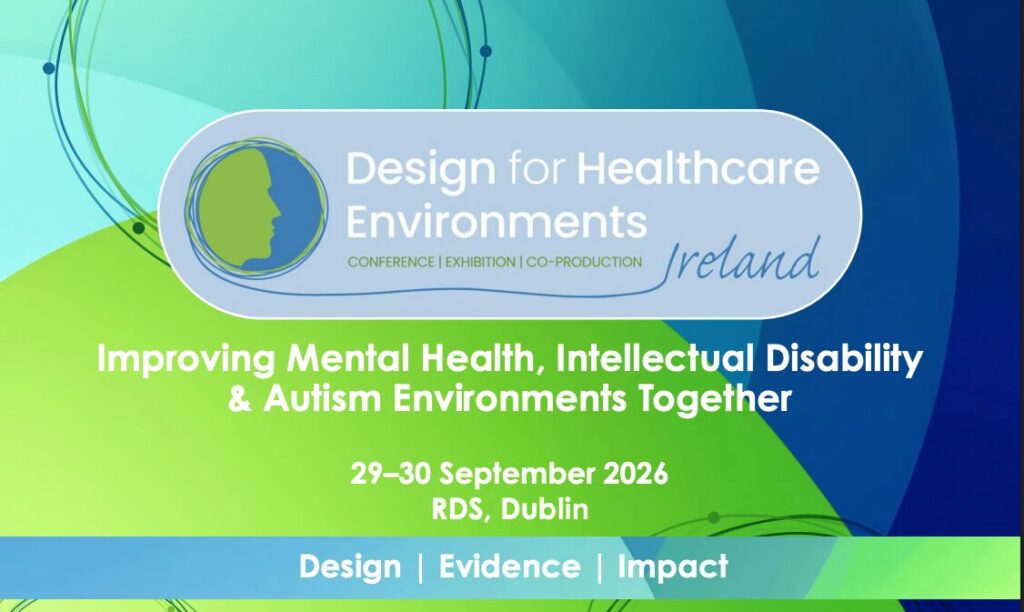
These ideas will be explored further in From Insight to Impact: Co-Producing Better Healthcare Environments, presented by Dehlia McCarthy and Paul Hendrick at Design for Healthcare Environments Ireland (DHEI).
Rather than offering a showcase of completed projects, their session will take delegates behind the process itself, sharing practical examples of how co-production, service design and human-centred thinking have helped uncover hidden challenges, reshape assumptions and improve healthcare experiences across Children’s Health Ireland.
More importantly, they hope delegates leave with the confidence to apply the same principles in their own organisations.
Whether you’re designing a new healthcare environment, reviewing an existing service or simply trying to solve a persistent challenge, the message is the same: start by understanding the problem, involve the people who live it every day and don’t be afraid to challenge your own assumptions.
Taking place at the RDS, Dublin, on 29–30 September 2026, Design for Healthcare Environments Ireland brings together clinicians, architects, designers, estates and facilities professionals, people with lived experience, researchers and policymakers to explore practical, evidence-informed approaches to creating safer, more therapeutic healthcare environments.
Dehlia McCarthy and Paul Hendrick will present From Insight to Impact: Co-Producing Better Healthcare Environments on Tuesday 29 September, 12:00–12:30 in Theatre A.
If this article has resonated with you, this session promises practical tools, honest reflections and real-world examples that you can take back to your own organisation.
Register now to join the conversation and discover how better questions can lead to better healthcare environments.