
As approaches to mental health and dementia care evolve, the environments in which care takes place must evolve too. Ahead of the Mental Health & Dementia Facilities Forum 2026, Design in Mental Health Network explores the challenges, ideas and practical innovations shaping the next generation of care environments.
What does it mean to design an environment that genuinely supports someone experiencing mental distress?
How can a building help someone feel safe without making them feel restricted? How do we create spaces that support independence while responding to complex clinical needs? And how can healthcare organisations balance ambitious design principles with the practical realities of existing buildings, limited resources and increasing operational demands?
These questions sit at the heart of the Mental Health & Dementia Facilities Forum (MHDF), taking place on 24–25 November 2026 at The Belfry Hotel & Resort, Sutton Coldfield.
Under the theme Environments That Promote Mental Wellbeing, Recovery & Resilience, the Forum will bring together professionals working across mental health and dementia care, architecture, healthcare estates, design and specialist services.
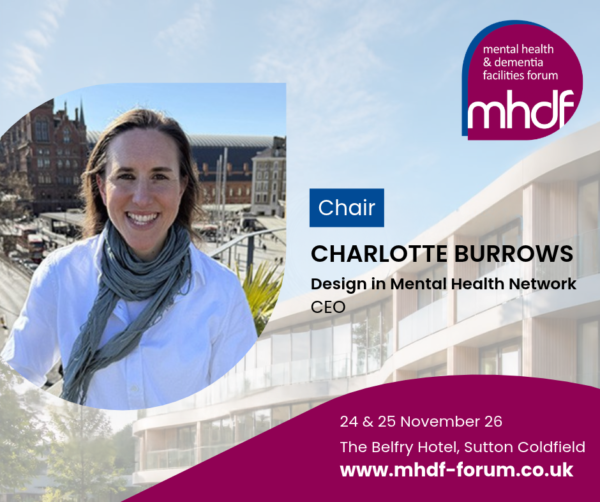
Chaired by Charlotte Burrows, Chief Executive of Design in Mental Health Network (DiMHN), the speaker programme brings several important perspectives together.
From trauma-informed design and emerging approaches to mental health urgent care to dementia support and the responsible use of artificial intelligence, the discussions reflect both the complexity of today’s challenges and the opportunities to improve the environments in which care is delivered.

Designing environments that recognise the impact of trauma
For people experiencing mental distress, the physical environment can have a profound influence on how safe, comfortable and supported they feel.
An unfamiliar setting, excessive noise, limited privacy or a perceived lack of control can contribute to an already difficult experience.
This is particularly relevant in secure therapeutic environments, where the need to manage risk must be carefully balanced with the need to preserve dignity and support recovery.
At MHDF 2026, Gerry Guerrero, Global Director, Civic at HDR, will explore this challenge in his presentation, Trauma-informed Environments.
Drawing on the TiD Framework, Gerry will introduce a trauma-informed design methodology for secure therapeutic settings.
His presentation will consider how thoughtful spatial design can help reduce environmental stressors, minimise potential trauma triggers and create conditions that foster dignity and resilience.
This raises an important question for everyone involved in planning and delivering mental health facilities.
Are we designing environments primarily around managing risk, or are we giving equal consideration to how people experience those environments

These priorities need not be mutually exclusive.
At DiMHN, we see that understanding people’s lived experiences, alongside clinical knowledge and design evidence, is essential to making better decisions.
Trauma-informed design encourages us to look beyond individual products and technical specifications to consider the wider experience of a space.
How does someone feel when they enter? Can they understand where they are and where they need to go? Do they have opportunities for privacy, connection and meaningful choice?
These considerations are central to creating environments that support people rather than simply accommodate them.
Rethinking mental health urgent care
One of the most significant conversations in mental health design concerns the environments in which people receive urgent support during a crisis.
For someone experiencing acute distress, the physical setting can influence their sense of safety, dignity and trust.
Yet mental health urgent care must often be delivered within complex healthcare estates, where space, resources and competing operational requirements create considerable challenges.
As new models of mental health urgent care emerge, there is an opportunity to reconsider how these environments are planned and designed.
This will be the focus of a panel discussion at MHDF 2026:
Shaping the Future of Mental Health Urgent Care: Environments for Safety, Dignity and Better Outcomes.
Hosted by Charlotte Burrows, Chief Executive of DiMHN, and Maria Luigia Assirelli, Director at Floyd Slaski Architects, the discussion will bring together:
– Simon Leslie, Senior Capital Project Manager, South London & Maudsley NHS Trust, who delivered the new Maudsley Urgent Treatment Centre.
– Hannah Wildsmith, Head of Mental Health, Nottingham University Hospitals NHS Trust.
– Rhian Davidson, Healthcare Specialist Consultant, Altro.
The panel will explore the evolving approach to Mental Health Emergency Departments, including the newly published Good Design Principles developed jointly by NHS England and DiMHN.
These principles provide an important starting point for considering how urgent care environments can better respond to the needs of people experiencing mental distress.
But translating principles into practice is rarely straightforward.
How can existing facilities be adapted to create more supportive environments? What can be achieved within constrained budgets? How can design respond to clinical requirements without creating unnecessarily institutional spaces?
And critically, how can the experiences of people receiving and delivering care inform those decisions?
By bringing together capital project experience, healthcare expertise and specialist design knowledge, the panel will explore how emerging thinking can be applied to real-world challenges.
For DiMHN, this reflects a wider priority: ensuring that evidence and good practice do not remain theoretical, but help inform the decisions that shape everyday care environments.




Transforming dementia support through collaboration
The need for more thoughtful, person-centred environments extends beyond mental health inpatient and urgent care settings.
For people living with dementia, the accessibility, familiarity and organisation of services can make an important difference to their experience of care and support.
Yet families can face considerable challenges navigating different services, understanding what support is available and finding the right help at the right time.
Creating more connected approaches requires collaboration across health, care, community organisations and the people who use those services.
At MHDF 2026, James Wilcox, Project Lead for the West Berkshire Dementia Hub, will share the story behind an ambitious local initiative in his presentation: Transforming Local Dementia Support.
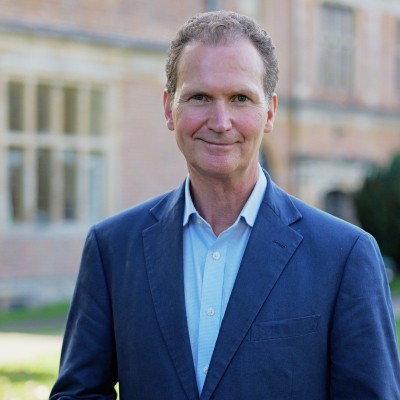
The project began five years ago through a conversation between James, then Chief Executive of Age Concern Newbury, and the Chief Executive of Greenham Trust.
Recognising the difficulties experienced by families living with dementia, they began exploring how local support could be transformed.
Following an extensive period of research and development, a new charity was established to help turn that ambition into reality.
James will outline the project’s development and consider how its collaborative approach could provide lessons for other communities.
The initiative highlights an important principle.
Better care environments begin with understanding what people need, rather than assuming existing service arrangements provide the right starting point.
For architects, designers, commissioners and care providers, this means considering not only the physical characteristics of a building, but how services connect and how people experience the wider journey of care.
It also reinforces the importance of genuine collaboration.
When communities, people with lived experience, care professionals and delivery partners contribute to shaping a project, there is greater opportunity to create environments and services that respond to real needs.
Can artificial intelligence help create safer healthcare environments?
While the design of a healthcare facility has an important influence on people’s experiences, its ongoing management is equally critical.
Mental health and dementia estates present demanding operational and compliance responsibilities.
Estates and facilities teams must navigate complex requirements relating to building safety, maintenance, risk assessment and regulatory guidance, often across multiple sites and systems.
Much of the information needed to demonstrate compliance can be dispersed across spreadsheets, documents and separate organisational processes.
This creates a significant administrative burden for teams already managing complex responsibilities.
At MHDF 2026, Dr Carl-Magnus von Behr, CEO and Co-Founder of CompliMind Ltd, will explore how artificial intelligence could help address some of these challenges.
His presentation, Compliance Without the Burden: How AI Can Support Safer Mental Health Facilities, will examine how AI-enabled tools can help estates and facilities teams bring together scattered compliance evidence.
The session will consider opportunities to identify outstanding actions, highlight potential gaps and make relevant information easier to retrieve when preparing for inspections.
Importantly, it will also address the limitations of AI and the governance required for its responsible use.
Technology cannot replace professional judgement, clinical expertise or effective organisational accountability.
However, appropriately designed tools may help professionals spend less time searching for information and more time addressing the issues that matter.
For those responsible for mental health environments, the question is not simply whether new technology can make processes faster.
It is whether it can support better-informed decisions, stronger assurance and ultimately safer environments for the people who use them.

Connecting design principles with everyday practice
Although these presentations address different challenges, they share a common concern.
How do we translate good intentions, professional expertise and emerging knowledge into environments that genuinely work better for people?
Trauma-informed design asks us to consider the emotional impact of physical spaces.
Mental health urgent care challenges us to rethink how environments support people at moments of acute distress.
Community dementia initiatives demonstrate the importance of understanding people’s needs and building services around them.
And developments in AI highlight opportunities to improve the systems that help keep healthcare environments safe and operationally effective.
None of these challenges can be addressed through design alone.
They require collaboration between people with lived experience, clinicians, architects, estates professionals, commissioners, researchers, technology providers and the wider healthcare community.
They also require a willingness to challenge established assumptions.
At DiMHN, we believe that design is never neutral.
Every environment influences how people experience care, how they interact with others and how much dignity, choice and control they feel they have.
Our role is to bring together evidence, lived experience and professional expertise to help the sector make more informed decisions.
The conversations taking place at MHDF 2026 offer an opportunity to advance that work.

Join the conversation at MHDF 2026
The Mental Health & Dementia Facilities Forum provides a setting for professionals to share ideas, explore practical challenges and develop connections across the sector.
Alongside the speaker programme, delegates will have opportunities to participate in pre-arranged one-to-one meetings and informal networking.
A project delegate drinks reception on Monday 23 November will also provide an opportunity to connect ahead of the main Forum.
For anyone involved in planning, designing, delivering or managing mental health and dementia environments, the event offers an opportunity to consider what better practice could look like and how we can work together to achieve it.
Because the challenge is not simply to create safer buildings or more efficient facilities.
It is to create environments that recognise people’s needs, respect their dignity and provide better opportunities for wellbeing and recovery.
Mental Health & Dementia Facilities Forum 2026
24–25 November 2026
The Belfry Hotel & Resort, Sutton Coldfield
Project Delegate Drinks Reception: Monday 23 November
Better connections, better environments